

Largest Corporate Mergers News Update: What Changed and What to Watch in 2026
The history of corporate consolidation is written in three figures: Vodafone’s 2000 acquisition of Mannesmann at approximately $202 billion, Pfizer’s $160 billion bid for Allergan in 2015, and Anheuser-Busch InBev’s $106 billion purchase of SABMiller. These mega-deals reshaped their respective industries and set benchmarks that continue to influence merger strategy across all sectors, including renewable energy.
Corporate mergers at this scale serve multiple strategic purposes. They eliminate competition, unlock market synergies, accelerate geographic expansion, and consolidate intellectual property under single ownership. The renewable energy sector has begun following this pattern, with solar manufacturers and project developers pursuing strategic acquisitions to achieve economies of scale in an increasingly competitive marketplace.
Understanding the mechanics and outcomes of record-breaking mergers provides valuable context for solar industry professionals navigating their own market’s consolidation phase. As installation costs decline and utility-scale projects demand larger capital commitments, the forces that drove beverage giants and pharmaceutical companies to merge are now reshaping the renewable energy landscape. The lessons from these historic transactions extend beyond their staggering valuations to reveal broader patterns in how industries mature, consolidate, and position themselves for long-term competitiveness.
Key Takeaway: Heightened regulatory oversight, new valuation drivers including intangible assets and data portfolios, and industry-specific consolidation pressures have fundamentally altered the mega-merger environment since the record-breaking deals of the early 2000s.
What Changed in the Mega-Merger Landscape

The mega-merger landscape has shifted dramatically in recent years, driven by three converging forces: tightening regulatory scrutiny, evolving valuation methodologies, and accelerating sector concentration. Antitrust authorities in the U.S. and Europe now scrutinize deals above $5 billion with unprecedented rigor, extending review timelines and imposing more structural remedies than in previous decades. This regulatory intensity has changed how companies approach mega-deals, with legal and compliance costs now representing a larger portion of total transaction expenses.
Valuation trends have evolved beyond traditional EBITDA multiples. Today’s largest mergers often hinge on intangible assets: intellectual property portfolios, customer data ecosystems, and market positioning in emerging technologies. Companies pursuing transformational combinations now build premiums around strategic capabilities rather than purely operational synergies, which partly explains why deal multiples have climbed even as interest rates fluctuate.
Sector concentration has reached historic levels in telecommunications, pharmaceuticals, consumer goods, and increasingly in energy infrastructure. Industries with high capital requirements and regulatory barriers see repeated waves of consolidation, as mid-tier players struggle to compete against mega-entities formed through prior mergers. This creates a self-reinforcing cycle where market leaders pursue additional acquisitions to maintain competitive moats, pushing deal values higher and reshaping entire industry structures. The renewable energy sector now follows this pattern, with solar manufacturers and developers consolidating to achieve the scale necessary for grid-level projects and international expansion.
Historic Mega-Mergers: The Deals That Set Records
1. Vodafone-Mannesmann Acquisition (2000): The $202 Billion Benchmark
The Vodafone AirTouch acquisition of Mannesmann stands as the benchmark for corporate mega-mergers, valued at approximately $202 billion when it closed in 2000. This cross-border deal united British telecommunications giant Vodafone with Germany’s Mannesmann in what became the largest corporate takeover in history at the time, with some sources citing Vodafone, Mannesmann valued at about $180 billion depending on currency fluctuations and measurement methodology.
The transaction reshaped the global telecommunications landscape by consolidating mobile network operations across Europe and creating what was then the world’s largest mobile carrier. The deal’s complexity extended beyond its unprecedented valuation. Vodafone faced significant regulatory scrutiny from multiple European competition authorities, navigated cultural differences between British and German corporate governance structures, and overcame initial resistance from Mannesmann’s management team. The hostile takeover required Vodafone to offer a substantial premium to shareholders, demonstrating how cross-border mega-mergers demand strategic persistence and deep financial resources to overcome regulatory, cultural, and political barriers that smaller deals rarely encounter.
2. Pfizer-Allergan Pharmaceutical Combination: The $160 Billion Deal
In 2015, pharmaceutical giants Pfizer Inc. and Allergan PLC announced a Pfizer, Allergan deal valued at $160 billion making it one of the largest corporate combinations in history. The merger represented a watershed moment in pharmaceutical consolidation, driven by the pursuit of scale economies in drug development and global market access.
What made this transaction particularly notable was its structure as a tax inversion deal. Pfizer planned to redomicile to Ireland, where Allergan was based, to benefit from lower corporate tax rates. This strategy sparked intense regulatory scrutiny and public debate about the balance between shareholder value creation and tax policy.
The pharmaceutical sector’s consolidation trend stems from several pressures: escalating R&D costs for new drug development, patent cliff concerns as blockbuster medications lose exclusivity, and the need for diversified product portfolios to sustain revenue growth. Mega-mergers like Pfizer-Allergan aimed to address these challenges through combined pipeline strength and operational efficiencies.
Ultimately, the deal collapsed in 2016 after the U.S. Treasury Department introduced new rules specifically targeting tax inversion transactions. The termination illustrated how regulatory environments can derail even the most carefully structured mega-deals, a lesson that applies across all sectors pursuing transformational M&A.
3. Anheuser-Busch InBev and SABMiller: The $106 Billion Brewing Giant
The SABMiller PLC tie-up with Anheuser-Busch InBev, worth $106 billion, stands as one of the most significant consumer goods consolidations in corporate history. This deal reshaped the global beer industry by uniting two brewing powerhouses, creating a company that controls roughly one-third of worldwide beer production. The merger combined SABMiller’s strength in emerging markets like Africa and Latin America with AB InBev’s established presence in North America and Europe, giving the combined entity unmatched distribution reach and brand portfolio depth.
The transaction faced intense regulatory scrutiny across multiple jurisdictions, requiring the divestiture of several regional brands to satisfy antitrust authorities concerned about market concentration. Unlike many Notable pending deals that rely heavily on stock swaps, this acquisition involved substantial cash components to secure shareholder approval. The deal’s completion demonstrated how mega-mergers in mature industries prioritize scale advantages and cost synergies, achieving immediate market dominance through consolidation rather than organic growth strategies that could take decades to deliver comparable results.
Why These Mega-Mergers Matter for Solar and Energy Markets
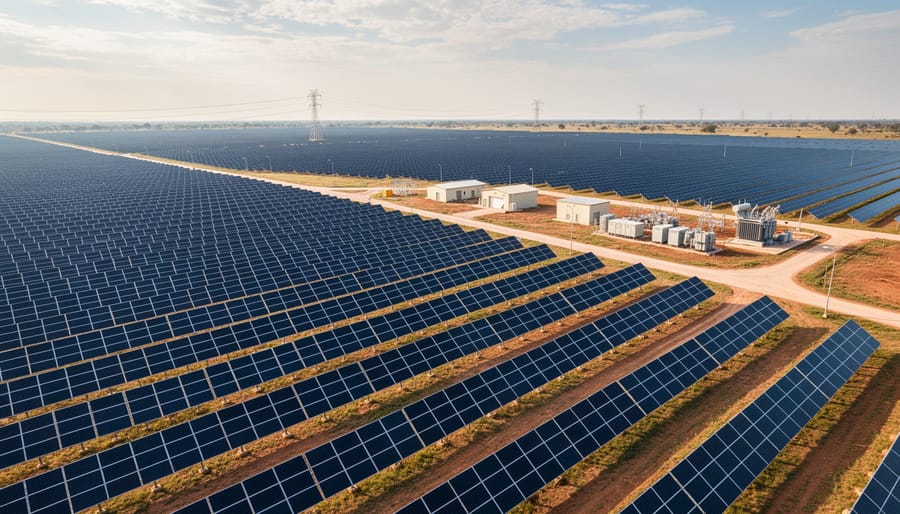
The M&A playbook from traditional industries offers crucial insights for solar sector participants navigating rapid consolidation. When telecommunications, pharmaceuticals, and consumer goods giants pursued mega-mergers worth $100 billion or more, they demonstrated how market dominance, supply chain control, and technology acquisition drive transformational deals. These same motivations now shape renewable energy consolidation, where major solar companies pursue strategic combinations to secure competitive advantages.
Solar professionals should monitor three critical patterns emerging from historic mega-merger activity:
- Vertical integration strategies that combine manufacturing, development, and installation capabilities under single ownership
- Cross-border acquisitions that secure access to critical supply chains, particularly for solar panels and battery storage components
- Technology-driven deals where established energy companies acquire clean tech innovators to accelerate transition capabilities
- Geographic expansion mergers that rapidly establish national or regional market presence
The solar industry’s consolidation trajectory mirrors the pharmaceutical sector’s pattern, where Pfizer’s $160 billion Allergan acquisition demonstrated how companies combine complementary portfolios to dominate market segments. Solar manufacturers and developers increasingly pursue similar strategies, merging to achieve economies of scale that reduce per-watt costs and expand project pipelines. This concentration creates both opportunities and challenges: larger entities can negotiate better component pricing and financing terms, but smaller contractors may face intensified competition from vertically integrated rivals.
Regulatory scrutiny represents another crucial lesson from mega-mergers. The Vodafone-Mannesmann deal navigated complex cross-border approvals, establishing precedents that now apply to international solar supply chain acquisitions. Solar professionals tracking M&A activity should assess how deals might consolidate regional markets, affect component availability, or shift competitive dynamics within their service territories. Understanding these consolidation patterns helps contractors anticipate partner reliability, pricing pressures, and market entry strategies from newly enlarged competitors.
M&A Deal Structures and Valuation Drivers
Mega-mergers employ diverse structural frameworks that reflect strategic priorities, financing constraints, and regulatory landscapes. The choice between all-cash, all-stock, or hybrid consideration shapes deal feasibility and stakeholder outcomes.
Cash transactions deliver immediate liquidity to sellers but demand substantial capital reserves or financing commitments from acquirers. The Men’s Wearhouse acquisition of Jos. A. Bank for approximately $1.8 billion in cash exemplifies this straightforward approach, eliminating valuation uncertainties tied to acquirer share price fluctuations. Stock-based deals like the Vodafone-Mannesmann transaction conserve acquirer cash while aligning seller interests with combined entity performance, though they introduce execution risk from market volatility between announcement and closing.
Valuation drivers in record-breaking mergers extend beyond simple earnings multiples. Strategic premiums reflect expected synergies, market share consolidation, and access to proprietary capabilities. The $160 billion Pfizer-Allergan combination commanded valuations based on drug pipeline potential and regulatory arbitrage opportunities. Scale economies, geographic expansion, and technology acquisition justify premiums that can exceed 30-50% above standalone market values.
Regulatory approval processes impose critical path constraints. Antitrust authorities scrutinize competitive impacts, often requiring divestitures as closing conditions. Cross-border transactions face multiple jurisdictional reviews, extending timelines to 12-18 months for complex deals. Solar industry professionals tracking consolidation patterns should consider how asset management alternatives influence renewable energy M&A structures, where project portfolios and operational capabilities drive valuation metrics distinct from traditional manufacturing or consumer goods sectors.
What to Watch in 2026 and Beyond
Several sectors stand poised for unprecedented consolidation activity through 2027, with renewable energy leading the list. Solar manufacturing, utility-scale project development, and energy storage companies face pressure to achieve economies of scale that could drive valuations into mega-merger territory. Watch for deals combining solar panel production with installation capacity or project pipelines, creating vertically integrated players that control multiple value chain segments. Companies offering comprehensive services from a solar installation guide through ongoing maintenance may become attractive acquisition targets as larger firms seek to capture end-to-end customer relationships.
Note: Federal antitrust scrutiny has intensified for energy sector consolidation, with regulators examining whether mega-mergers in clean technology could limit competition and innovation in critical infrastructure markets.
Track three valuation metrics that signal when deals might reach historic scale: enterprise value-to-revenue multiples above 10x in high-growth sectors, cash reserves exceeding $50 billion at potential acquirers, and market capitalizations that double within 18 months. Regulatory developments merit close attention, particularly around cross-border approvals and antitrust review timelines, which have extended significantly compared to the Vodafone-Mannesmann era. For solar professionals, monitor consolidation among tier-one module manufacturers and utility-scale developers, as these segments show the clearest path to deals exceeding $20 billion in the next 24 months.
Frequently Asked Questions

What qualifies as a mega-merger?
Industry analysts typically classify deals exceeding $50 billion in total transaction value as mega-mergers, though the threshold continues to rise as markets expand. The largest deals, like the Vodafone-Mannesmann acquisition valued at approximately $202 billion, set benchmarks that define this category.
How are deal values calculated in largest corporate mergers?
Transaction values combine the purchase price of all outstanding shares, assumption of target company debt, and any cash or stock consideration paid to shareholders. The Pfizer-Allergan deal worth $160 billion, for example, reflected total enterprise value rather than just equity purchase price.
What approval processes do mega-mergers face?
Largest mergers require antitrust review from regulatory bodies in every jurisdiction where the companies operate, shareholder votes from both acquiring and target companies, and often sector-specific regulatory clearance. Cross-border deals face additional complexity from multiple national competition authorities reviewing market concentration impacts.
Why do some industries see more mega-mergers than others?
Capital-intensive sectors with high barriers to entry, telecommunications, pharmaceuticals, consumer goods, and energy, tend to produce the largest deals because scale delivers operational efficiencies and market leverage. The $106 billion SABMiller-Anheuser-Busch InBev combination exemplifies how mature industries consolidate to control distribution networks and reduce competition.
These patterns apply directly to solar sector consolidation, where manufacturing scale, project development capacity, and supply chain control increasingly drive M&A activity. Solar professionals monitoring potential mega-mergers should track regulatory signals around market concentration limits and cross-border investment restrictions that could enable or block transformative deals in renewable energy sectors.