12 Major Solar Installers in Maryland for Your 2026 Project
Maryland property owners and procurement teams looking to install solar panels have access to more than 100 licensed contractors across the state, but choosing the right installer requires more than a quick web search. This guide profiles 12 established solar installers serving Maryland in 2026, selected for their verified state presence, licensing credentials, installation volume, and track record with both residential and commercial projects.
The Maryland solar market has grown steadily alongside the state’s Solar Renewable Energy Credit program and favorable net metering policies, creating opportunities for property owners while also increasing the number of firms claiming installation capabilities. Some are major U.S. solar companies with national reach, while others focus exclusively on the Mid-Atlantic region. Size alone does not determine quality, but understanding each installer’s scope, service area, and specialization helps narrow the field.
This list provides enough detail to begin vetting contractors: company headquarters, service territories within Maryland, project type focus, and relevant certifications. Because installer performance can vary significantly even within a single company, we also outline the verification steps that procurement professionals use to confirm credentials, review project references, and assess financial stability before issuing contracts. The goal is not to rank these installers, but to surface the information needed to build a qualified shortlist and move confidently into the proposal phase.
Key Takeaway: Maryland’s combination of state tax credits, active SREC market, and guaranteed net metering creates favorable economics that have attracted established regional and national installers. Understanding which incentives apply to your project type helps narrow contractor selection.
How We Identified Maryland’s Leading Solar Installers
We evaluated Maryland solar installers against objective criteria that reflect operational capability and market standing. Our selection process prioritized contractors with measurable Maryland presence rather than those merely listing the state in their service area. The goal was to identify installers who can demonstrate both technical competence and sustained local operations.
Each installer on this list met minimum thresholds across multiple dimensions. We examined their Maryland-specific project portfolios, looking for documented installations rather than marketing claims. Contractors with verifiable commercial or residential projects in Maryland scored higher than those with limited in-state work. We also assessed how their capabilities fit within the broader solar contractor landscape comparing Maryland operations to national benchmarks.
Our core selection criteria included:
- Active Maryland contractor license and current insurance coverage meeting state requirements
- Minimum three years of documented solar installation experience in Maryland or adjacent Mid-Atlantic states
- NABCEP-certified installers on staff or equivalent manufacturer-specific certifications
- Verifiable project portfolio with Maryland installations across target market segments
- Customer review patterns showing consistent service delivery, not isolated positive testimonials
- Comprehensive warranty coverage addressing both equipment and workmanship for Maryland climate conditions
- Transparent equipment partnerships with tier-one manufacturers maintaining U.S. distribution networks
These criteria allow industry professionals to understand why each contractor appears in this list. They reflect the due diligence standards procurement teams should apply when evaluating installers for commercial projects or residential programs. No installer paid for inclusion, and rankings do not reflect advertising relationships. The list represents contractors who have built measurable Maryland operations through consistent project delivery.
1. Solar Energy World, Established Maryland Presence
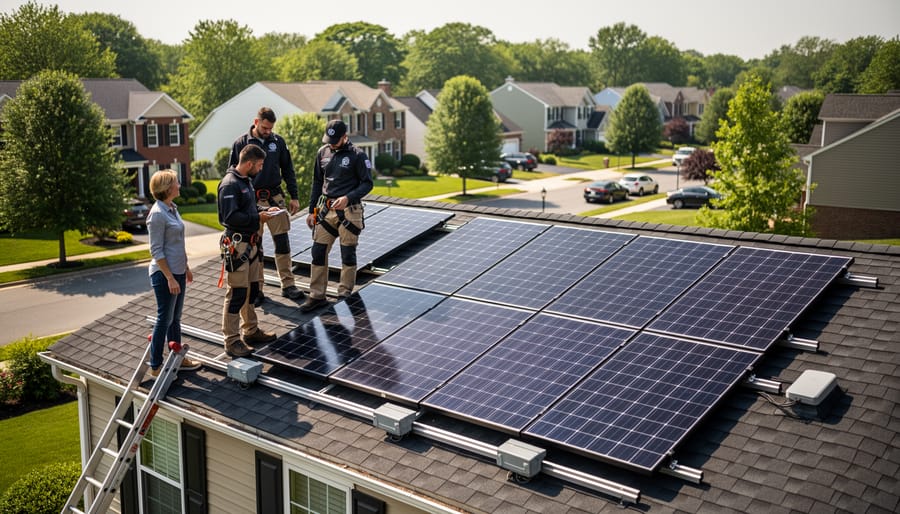
Solar Energy World operates as one of Maryland’s longest-standing solar contractors, with headquarters in Elkridge and service coverage extending across the Baltimore-Washington corridor and the Eastern Shore. The company handles residential installations typically ranging from 5 to 15 kW and commercial projects scaling from 50 kW to multi-megawatt arrays for industrial facilities and municipal buildings.
Their equipment partnerships include tier-one panel manufacturers such as REC Solar and Q CELLS, paired with inverter platforms from Enphase and SolarEdge depending on project requirements. Solar Energy World maintains NABCEP-certified installation crews and holds Maryland Home Improvement Commission (MHIC) licensing along with electrical contractor credentials in multiple jurisdictions.
The company distinguishes itself through direct employment of installation teams rather than subcontracting, which provides consistent quality control across projects. Their commercial division has completed notable installations for Maryland school districts, warehouses, and agricultural operations. Warranty coverage includes 25-year panel performance guarantees backed by manufacturer agreements and 10-year workmanship warranties on installation labor. For procurement teams evaluating Maryland contractors, Solar Energy World’s local presence since 2009 provides verifiable project history and established service infrastructure within the state.
2. Lumina Solar, Regional Specialist
Lumina Solar operates as a Mid-Atlantic-focused installer with established presence across Maryland, Virginia, and surrounding markets. The company positions itself between larger national chains and hyperlocal single-state contractors, maintaining dedicated Maryland teams while leveraging regional buying power and standardized installation processes across multiple service territories.
Maryland operations cover Montgomery, Howard, Anne Arundel, and Baltimore counties, with residential installations comprising the majority of their project portfolio. Commercial work includes small-to-medium business rooftop arrays, typically under 200 kW, though the company handles select larger commercial projects through its regional infrastructure.
Lumina’s service model emphasizes in-house installation crews rather than subcontractor networks, which provides quality control consistency but can extend scheduling timelines during peak demand periods. The company offers multiple equipment tiers, economy, mid-range, and premium, allowing customers to match budget constraints with performance expectations. Financing options include solar loans and lease structures, with direct relationships to several regional lenders.
Their market positioning targets homeowners seeking middle-tier pricing with established regional reputation rather than lowest-cost or premium-only options. Customer reviews consistently reference responsive project management and post-installation service, though lead times can reach 8-12 weeks during spring and summer installation seasons when demand peaks across their multi-state footprint.
3. Trinity Solar, National Scale, Local Service
Trinity Solar operates in Maryland as part of a national network spanning multiple East Coast states, bringing institutional resources to residential installations while maintaining local installation teams. Founded in 2004, the company has completed over 65,000 residential solar projects across its service territory, with Maryland representing a core market where it fields dedicated crews and project managers.
The company’s Maryland operations focus exclusively on the residential segment, typically handling systems ranging from 6 kW to 12 kW for single-family homes. Trinity Solar self-performs installations rather than subcontracting labor, a practice that provides direct quality control but limits geographic flexibility compared to installers using local subcontractor networks. Maryland crews receive centralized training through the company’s New Jersey headquarters, standardizing installation procedures across the region.
Trinity Solar differentiates itself through proprietary financing programs developed in partnership with regional lenders, offering solar loans and lease options structured specifically for Mid-Atlantic markets. The company manufactures its own racking systems and maintains warehouse inventory in the Baltimore-Washington corridor, reducing lead times for common residential components. Warranty coverage includes 25-year production guarantees backed by the parent company’s balance sheet, a consideration for homeowners evaluating long-term installer solvency. Maryland customers work with assigned project coordinators who handle permitting, utility interconnection, and inspection scheduling through local jurisdictions.
4. Astrum Solar, Customer-Focused Installer
Astrum Solar operates throughout Maryland’s residential market with a service model that prioritizes customer education and project transparency. The company maintains crews in the Baltimore, Washington corridor and surrounding counties, handling installations from initial consultation through final inspection and interconnection.
Their customer service approach centers on assigned project coordinators who guide homeowners through system design, permitting, and utility paperwork. Astrum provides in-house financing options alongside third-party solar loans and lease programs, enabling side-by-side comparisons of ownership versus PPA structures. Homeowners receive itemized proposals that break down equipment costs, labor, and projected savings before signing.
Project management follows a structured timeline: site assessment and engineering within two weeks, permit submission within five business days of contract signing, and installation scheduled based on AHJ approval. Astrum’s crews typically complete residential installations in one to three days depending on system size.
The company offers 25-year warranties on panels, 10-year inverter coverage, and workmanship guarantees that transfer with home sales. Post-installation monitoring uses manufacturer portals that track production and alert both homeowner and installer to performance anomalies requiring service response.
5. Sunpower by ESI, Premium Tier Provider
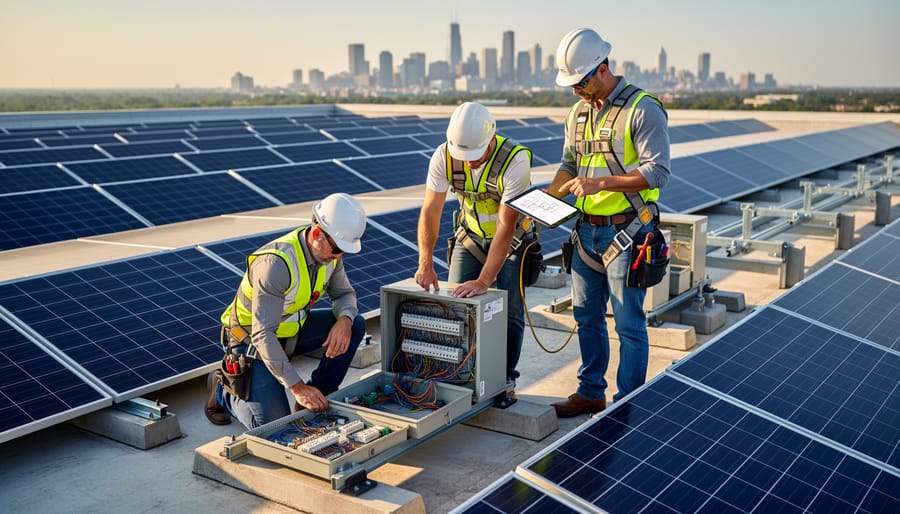
SunPower by ESI operates as a certified SunPower network installer serving residential and commercial markets across Maryland. The company’s primary differentiator lies in its exclusive access to SunPower Maxeon panels, which carry higher efficiency ratings than most conventional modules, typically 22-23% versus the industry average of 19-20%. This equipment tier appeals to projects with limited roof space or where maximum output per square foot drives the design.
ESI’s Maryland operations center on the Baltimore-Washington corridor, extending to suburban and rural territories where premium equipment demand exists. The installer handles projects ranging from residential arrays to commercial installations in the 50-500 kW range, positioning itself above entry-level contractors but below utility-scale developers.
The warranty structure reflects SunPower’s manufacturer backing: 25-year product coverage on panels, 25-year power output guarantee, and comprehensive workmanship protection through the network installer. This extended coverage appeals to commercial clients evaluating long-term asset protection and residential customers willing to pay a premium for reduced replacement risk.
ESI maintains in-house engineering and design capabilities, handling permit packages, interconnection applications, and utility coordination without outsourcing. Their commercial portfolio includes retail locations, office buildings, and light industrial facilities where roof condition and aesthetic integration justify higher upfront costs. The company’s pricing typically runs 15-25% above regional averages, reflecting the SunPower equipment premium and network certification requirements.
6. Maryland Solar Solutions, Local Independent
Maryland Solar Solutions operates as an independent installer with focused regional expertise across central Maryland counties. Based in Columbia, the company maintains service territories throughout Howard, Anne Arundel, Baltimore, and Montgomery counties, positioning its teams for rapid response and repeat project experience within these markets.
The installer’s portfolio splits roughly 70/30 between residential and commercial installations, with commercial work concentrated in small to mid-sized business facilities (10-100 kW systems). This mixed project base allows the company to maintain steady workflow while developing specialized knowledge of local utility interconnection procedures across multiple Maryland utilities including BGE, Pepco, and Delmarva Power.
Maryland Solar Solutions emphasizes local procurement relationships and direct equipment sourcing from U.S.-based manufacturers. The company’s technical teams handle permitting, design, and installation without subcontracting core functions, which provides tighter project control but limits scaling capacity compared to larger regional competitors.
Local market knowledge extends to Maryland’s SREC market dynamics, county-specific permitting requirements, and neighborhood-level installation considerations such as historic district restrictions and HOA solar policies prevalent in planned communities throughout their service territory. This granular understanding becomes particularly valuable for complex residential installations requiring variance approvals or custom mounting solutions.
7. Tetra Tech, Engineering-Led Approach
Tetra Tech distinguishes itself in Maryland’s solar market through its parent company’s engineering heritage and technical project execution. Operating as part of a global infrastructure consultancy, the Maryland solar division leverages in-house electrical and structural engineering teams for commercial and utility-scale installations that require complex site integration.
The company focuses primarily on projects exceeding 500 kW, including rooftop arrays for industrial facilities, ground-mount systems for municipalities, and community solar developments. Tetra Tech’s engineering-first approach enables custom solutions for challenging sites, facilities with unique structural requirements, contaminated brownfield redevelopment, or installations requiring detailed interconnection studies.
Maryland projects showcase this technical depth: multi-megawatt arrays designed around existing utility infrastructure, carport installations engineered for specific snow load and wind ratings, and systems integrated with on-site microgrids. The firm handles permitting, interconnection applications, and utility coordination directly, reducing timeline friction for commercial clients.
For procurement teams evaluating contractors for technically demanding Maryland solar projects, Tetra Tech offers specialized engineering capabilities that smaller residential installers typically subcontract. Project delivery follows design-build methodology with dedicated engineering oversight through commissioning.
8. Standard Solar, Commercial Specialist
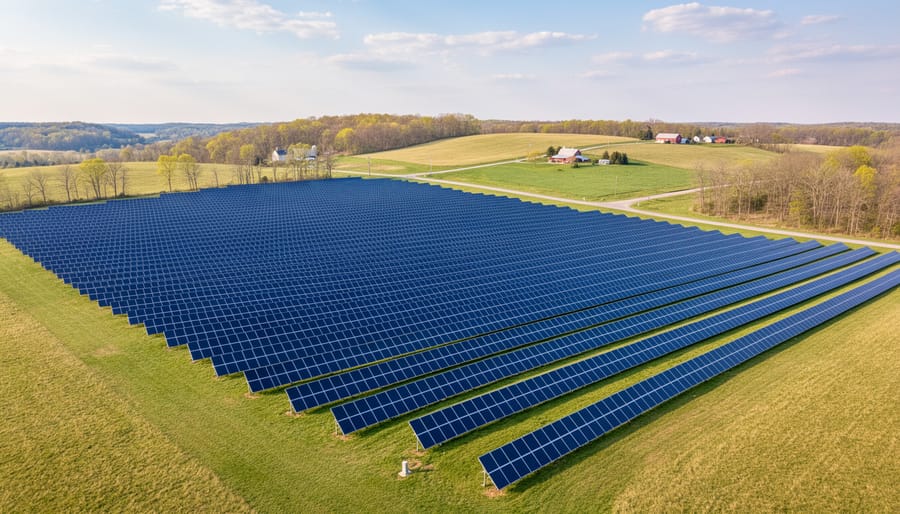
Standard Solar operates as a dedicated commercial and community solar developer with deep Maryland roots, having completed over 400 MW of solar projects across the Mid-Atlantic since its founding in 2004. The company’s Maryland portfolio includes large-scale commercial installations for corporate clients, municipalities, and educational institutions, alongside several community solar arrays that serve residential subscribers through Maryland’s community solar pilot program.
Unlike residential-focused installers, Standard Solar specializes in projects ranging from 500 kW rooftop arrays to multi-megawatt ground-mount systems. Their in-house engineering and development teams manage the full project lifecycle, from site assessment and interconnection applications through construction management and long-term operations. This vertical integration allows them to serve as both installer and ongoing asset manager for commercial property owners seeking performance monitoring and maintenance after commissioning.
Standard Solar maintains established relationships with Maryland’s major utilities and has navigated PJM interconnection processes for numerous projects. Their commercial client base includes corporations seeking to meet sustainability targets and real estate developers integrating solar into new construction. The company’s community solar program connects subscribers who lack suitable rooftops to locally-sited arrays, providing bill credits through virtual net metering arrangements approved under Maryland’s renewable energy framework.
9. Prospect Solar, Residential Installer
Prospect Solar operates primarily in Maryland’s residential solar market, concentrating on single-family installations across the Baltimore metro area and surrounding counties. The company positions itself as a direct-to-consumer installer with an emphasis on simplified project workflows and transparent pricing for homeowners.
Their service model centers on in-house project management from site assessment through final inspection. Prospect Solar employs salaried installation crews rather than subcontractors, which provides greater control over workmanship standards and project timelines. Typical residential installations range from 6 kW to 12 kW system sizes, matching average household consumption patterns in Maryland.
Battery storage integration has become a standard offering in Prospect Solar’s residential proposals, reflecting growing homeowner interest in backup power capabilities. The company pairs solar arrays with Tesla Powerwall and Enphase battery systems, providing customers with options at different price points and capacity levels.
Customer acquisition relies heavily on digital marketing channels and referral programs rather than door-to-door canvassing. This approach attracts homeowners who have already researched solar options and seek detailed system specifications and financing comparisons. Prospect Solar offers multiple financing structures including purchase, loan, and lease arrangements, though cash purchases and financed ownership dominate their project mix in Maryland’s current market environment.
10. Renewable Energy Systems (RES), Utility-Scale Developer
Renewable Energy Systems Americas operates in Maryland as a utility-scale developer and EPC contractor rather than a residential installer. The company’s Maryland portfolio centers on multi-megawatt solar farms and commercial installations exceeding 1 MW, positioning RES outside the typical homeowner or small business installer category.
RES’s Maryland projects include utility-scale developments in rural counties where land availability and transmission access support large-scale generation. The company handles project development from site assessment through construction, providing engineering, procurement, and construction services for independent power producers and utility clients. Their Maryland work emphasizes greenfield solar farms and community solar projects that serve multiple off-takers through state programs.
As a global renewable energy developer with U.S. operations, RES brings engineering depth and construction management capabilities suited to complex projects requiring interconnection studies, permitting coordination with county authorities, and multi-phase construction timelines. The company typically engages with project developers, land owners pursuing ground-mount solar, and utilities expanding renewable generation rather than individual property owners.
Maryland solar professionals evaluating RES should recognize its focus on large-scale projects. The company’s operational model targets installations where project scale justifies dedicated engineering resources and multi-year development cycles, making it relevant primarily for utility procurement, community solar developers, and commercial entities pursuing campus-scale or portfolio installations across multiple Maryland sites.
11. SolarFit, Design-Build Contractor
SolarFit operates in Maryland as a design-build contractor serving commercial, nonprofit, and institutional clients requiring custom solar installations. The company handles in-house engineering and design work before moving to construction, which allows tighter integration between system specifications and field execution than typical design-bid-build procurement models.
Maryland projects span rooftop arrays on commercial buildings, ground-mount systems for industrial facilities, and carport installations for parking structures. SolarFit’s design team produces stamped engineering drawings specific to Maryland building codes and manages interconnection applications with utilities including BGE, Pepco, and Delmarva Power. This internal capacity shortens the timeline between signed contracts and construction mobilization compared to installers outsourcing design work.
The commercial focus means SolarFit handles larger installations requiring structural analysis, electrical coordination with facility managers, and phased construction to minimize business disruption. Projects typically range from 50 kW to multi-megawatt scale, with equipment selection driven by client performance requirements rather than residential-focused product lines common among leading installation services providers.
12. Vivint Solar (Now Sunrun), National Network
Sunrun acquired Vivint Solar in 2020, consolidating two of the nation’s largest residential installers into a single network that now serves Maryland homeowners. The combined entity operates as Sunrun, bringing Vivint’s established Maryland customer base under Sunrun’s national platform, technology infrastructure, and financing programs.
Sunrun’s Maryland operations focus exclusively on residential installations, typically ranging from 5 kW to 12 kW systems for single-family homes. The company’s scale, among the top solar installers nationally, enables standardized pricing, predictable timelines, and volume purchasing power for equipment. Most Maryland projects use Sunrun’s preferred panel and inverter partnerships, selected for warranty alignment and monitoring integration.
Financing remains a core differentiator. Sunrun offers solar leases, power purchase agreements (PPAs), and loan products directly through its platform, with credit approval and contract execution handled in-house rather than through third-party lenders. This vertical integration speeds the sales-to-installation cycle for Maryland customers who prefer low or zero upfront costs.
The company’s BrightBox battery system integrates with Maryland installations where backup power or time-of-use optimization makes economic sense. Monitoring occurs through Sunrun’s proprietary app, tracking production, consumption, and system alerts. Service requests route through centralized support rather than local technician dispatch, reflecting the national operational model.
What to Verify Before Selecting an Installer
Before committing to a solar contractor in Maryland, establish a verification framework that protects your investment and confirms installer credentials. Start with Maryland’s Home Improvement Commission (MHIC) license lookup to verify the contractor holds an active license and check for any disciplinary actions or bond claims. Cross-reference their Maryland LLC or corporation registration through the State Department of Assessments and Taxation to confirm legal business status.
Note: Maryland law requires all solar installers performing residential work to maintain an active MHIC license; verify this credential directly with the commission rather than relying on contractor-provided documentation.
Request certificates of insurance showing general liability coverage of at least $1 million and workers’ compensation if the installer employs field staff. For commercial projects, many procurement teams require $2 million in aggregate coverage. Ask for project references matching your installation scale and building type, a residential portfolio doesn’t demonstrate commercial flat-roof competency, and vice versa.
Examine equipment sourcing practices by requesting manufacturer datasheets and verifying serial number registration processes that protect warranty claims. Clarify post-installation service commitments in writing: who handles inverter replacements, monitoring system failures, and roof penetration issues five years out? Compare these operational details across multiple installers on U.S. solar company rankings to establish industry benchmarks for Maryland contractors.
Review the warranty enforcement track record by contacting past clients about claim processing speed and installer responsiveness when equipment failed. A 25-year warranty means nothing if the company routinely disputes coverage or delays service calls.
Maryland Solar Market Context for 2026
Maryland’s solar market in 2026 operates under a robust regulatory framework that directly influences installer operations and project economics. The state maintains a residential tax credit capped at $5,000 per installation, while the Solar Renewable Energy Credit (SREC) program continues to provide long-term revenue streams for system owners, though SREC prices have stabilized at lower levels compared to the 2010s peak. Net metering remains available through investor-owned utilities including Baltimore Gas and Electric, Potomac Electric Power Company, and Delmarva Power, allowing systems up to 2 MW to receive full retail credit for excess generation.
The Public Service Commission maintains oversight of installer interconnection processes, with standardized application procedures that experienced Maryland contractors navigate efficiently. Property Assessed Clean Energy (PACE) financing programs operate in several counties, offering an additional funding mechanism that commercial installers frequently leverage. This regulatory stability, combined with Maryland’s renewable portfolio standard requiring 50% clean energy by 2030, has created a sustained project pipeline that supports the operations of both local specialists and national firms. Contractors with established Maryland presence have invested in utility-specific interconnection expertise, local permitting knowledge across 23 counties and Baltimore City, and relationships with the state’s incentive administrators, operational advantages that streamline project delivery timelines.
Frequently Asked Questions
What licenses must Maryland solar installers hold?
Maryland requires solar contractors to hold either a Master Electrician license or a Home Improvement Contractor license depending on project scope. Electrician licensing is mandatory for grid-connected systems, while HVAC licensing applies to certain installation types. Verify active licensing through the Maryland Department of Labor before engaging any contractor.
How long does a typical residential solar installation take in Maryland?
From contract signing to system activation, expect 60 to 90 days for residential projects. Design and permitting typically consume 3-4 weeks, physical installation takes 1-3 days, and utility interconnection approval adds another 2-4 weeks. Commercial projects require longer timelines due to engineering complexity and larger permit requirements.
What should I compare when reviewing installer quotes?
Compare equipment specifications line-by-line, panel wattage, inverter type, racking system, and monitoring platform. Review warranty terms for workmanship, equipment, and production guarantees separately. Examine payment structures, including any performance-based incentives, and verify whether quotes include all permitting, interconnection, and inspection costs.
Which credentials matter most for commercial solar projects?
For commercial installations, prioritize contractors with NABCEP Commercial PV Installation Professional certification, proven experience in your project size range, and electrical contractors who employ licensed Master Electricians. Request references from similar commercial applications and verify their Maryland contractor license covers the scope of your project.
Beyond formal credentials, evaluate each installer’s familiarity with Maryland’s specific utility interconnection procedures. Different utilities, BGE, Pepco, Delmarva Power, maintain distinct application processes and technical requirements. Contractors with established relationships in your utility territory typically navigate approvals faster and troubleshoot interconnection issues more effectively. Ask how many projects they’ve completed under your specific utility and whether they employ dedicated permitting staff for Maryland jurisdictions.
Maryland’s solar contractor landscape offers options across every project tier, from residential retrofits to utility-scale developments. Your selection process should start with project requirements: match installer expertise to your installation scale, complexity, and timeline constraints. Commercial buyers evaluating multi-site portfolios need different contractor capabilities than single-location projects, just as residential installations demand different service models than community solar builds.
Three priorities cut through the selection noise. First, verify Maryland-specific credentials independently through state licensing boards and insurance carriers, not installer claims. Second, request project references in your application category and confirm completion dates, not just customer satisfaction scores. Third, compare equipment sourcing models: some installers maintain direct manufacturer relationships that influence warranty enforcement and component availability for future service needs.
The installers profiled here represent established Maryland operations, but qualification criteria matter more than brand recognition. Evaluate each contractor against your project’s technical specifications, financing structure, and post-installation service expectations. Request detailed proposals from at least three qualified installers to establish realistic cost baselines and identify capability gaps. The right Maryland solar contractor delivers verifiable installation expertise matched to your specific project parameters, not the broadest service territory or the longest company history.